 ESPCI web site


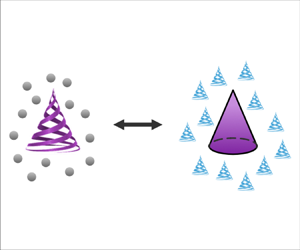 Chiral fluids – such as fluids under rotation or a magnetic field as well as synthetic and biological active fluids – flow in a different way than ordinary ones. Due to symmetries broken at the microscopic level, chiral fluids may have asymmetric stress and viscosity tensors, for example giving rise to a hydrostatic torque or non-dissipative (odd) and parity-violating viscosities. In this article, we investigate the motion of rigid bodies in such an anisotropic fluid in the incompressible Stokes regime through the mobility matrix, which encodes the response of a solid body to forces and torques. We demonstrate how the form of the mobility matrix, which is usually determined by particle geometry, can be analogously controlled by the symmetries of the fluid. By computing the mobility matrix for simple shapes in a three-dimensional (3-D) anisotropic chiral fluid, we predict counterintuitive phenomena such as motion at an angle to the direction of applied forces and spinning under the force of gravity.
Cambridge University Press
By: Tali Khain, Michel Fruchart, Colin Scheibner, Thomas A. Witten and Vincenzo Vitelli .
Published online by Cambridge University Press: 27 August 2024
DOI: https://doi.org/10.1017/jfm.2024.535