 ESPCI web site


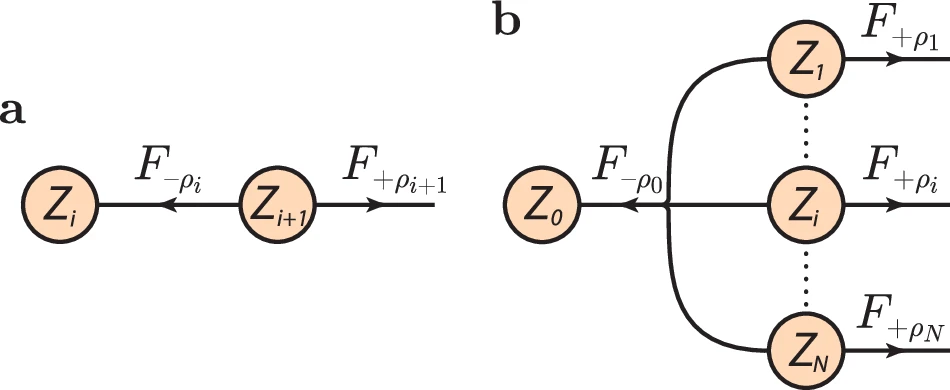 Autocatalytic chemical networks play a predominant role in a large number of natural systems such as in metabolic pathways and in ecological networks. Despite recent efforts, the precise impact of thermodynamic constraints on these networks remains elusive. In this work, we present a theoretical framework that allows specific bounds on the thermodynamic affinity and on the concentrations of autocatalysts in mass-action autocatalytic networks. These bounds can be obtained solely from the stoichiometry of the underlying chemical reaction network, and are independent from the numerical values of kinetic parameters. This property holds in the specific regime where all the fluxes of the network are tightly coupled and maximal. Our method is applicable to large networks, and can be used to complement constraints-based modeling methods of metabolic networks, which typically do not provide predictions about thermodynamic properties or concentration ranges of metabolites.
NATURE COMMUNICATIONS
By: Armand Despons, Yannick De Decker and David Lacoste.
Commun Phys 7, 224 (2024).
DOI: https://doi.org/10.1038/s42005-024-...