 ESPCI web site


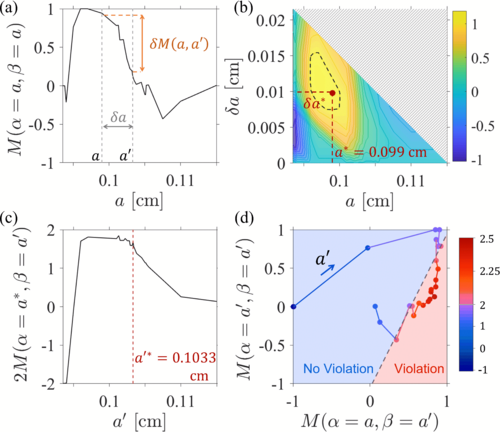 Since its discovery in 2005, the hydrodynamic pilot-wave system has provided a concrete macroscopic realization of wave-particle duality and concomitant classical analogs of a growing number of quantum effects. The question naturally arises as to how closely particle-particle correlations achieved with this classical system can mimic those arising on the quantum scale. We here introduce a new platform for addressing this question, a numerical model of cooperative tunneling in a bipartite pilot-wave hydrodynamic system. We execute a static Bell test, in which the system geometry is fixed and the two subsystems are coupled through the intervening wave field. This wave-mediated coupling is not congruent with the assumptions made in deriving Bell’s inequality, and so allows one to rationalize the reported violations. Nevertheless, these violations are elusive, and arise only in a limited corner of parameter space.
PHYSICAL REVIEW FLUIDS
By: Konstantinos Papatryfonos, Louis Vervoort, André Nachbin, Matthieu Labousse, and John W. M. Bush
Phys. Rev. Fluids 9, 084001 – Published 1 August 2024
DOI: https://doi.org/10.1103/PhysRevFlui...