ESPCI web site



Publications
-
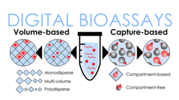
Digital bioassays through the lens of partitioning strategies
< Absolute quantification of biomolecules increasingly relies on digital bioassays, which convert continuous concentration measurements into binary, countable events distributed across a large number of independent partitions. Applying (...)
-
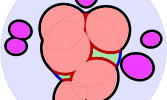
Residual Semi-crystalline Particles Released during Enzymatic Degradation of Plastics
< Enzymatic recycling of plastics is limited by the presence of semi-crystalline spherulites that are recalcitrant to enzymatic depolymerization. Depending on the quality of the waste stream and its treatment history, a large volume (...)
-
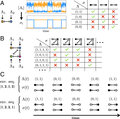
Learning to outgrow the competition: Reaction–diffusion systems that adapt to time-dependent environments
A fundamental challenge in both biology and engineering is understanding how adaptation can emerge from simple physical or chemical building blocks. Biological adaptation appears to rely on two key capabilities: information processing, to (...)
-
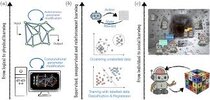
From active to odd to smart matter
The study of active matter has reshaped our understanding of collective states of matter far from equilibrium by proving that energy pumped into the microscopic scale leads to order on the macroscopic scale, collective motion, and anomalous (...)
-
Effect of solvent structure on the Wien effect and ionic correlations at the nanoscale
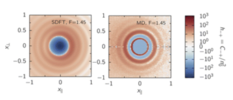
In this study, we examine how the structure of the solvent affects the correlations and conductivity of moderately concentrated electrolytes. We describe polar solvents with a nonlocal permittivity, ε(k), which we then incorporate into (...)
-
Compositional memory matters for early molecular systems
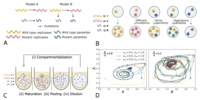
The error catastrophe refers to the proliferation of nonfunctional molecules in conditions where molecular replication has low accuracy, which is likely to correspond to conditions present at the Origin of Life. This error catastrophe can be (...)
-
pH gradient-driven deformation of a crista-like vesicle
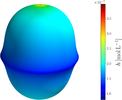
The inner membrane of mitochondria presents folds, the cristae, which are the production place of ATP. This synthesis is catalized by transmembrane proteins and relies on a flow of protons confined to the surface of the membrane. We posit that, (...)
-
Spreading and absorption of silicone oil droplets on silicone elastomer films
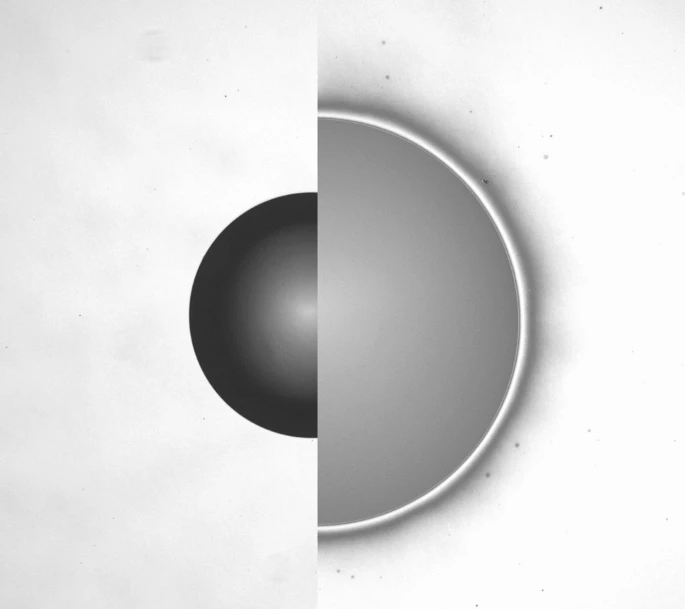
When a liquid droplet completely wets a hard substrate, its spreading dynamics follow Tanner’s law, with the droplet radius growing as the one-tenth power of time. Here, we investigate how these dynamics change when silicone oil droplets spread (...)
-
Tunable Poly(butylene oxide)-stat-polyglycidol Copolymers for Microfluidic-Assisted Nanoprecipitation Nanoparticle Design
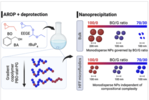
The self-assembly of amphiphilic copolymers into well-defined nanoparticles depends on the interplay among polymer composition, solvent exchange kinetics, and processing conditions. In this study, we explore the anionic ring-opening (...)
-
Symmetry-driven artificial phononic media
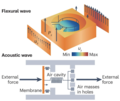
Phonons are quasiparticles associated with mechanical vibrations in materials. They are at the root of the propagation of sound and elastic waves, as well as of thermal phenomena, which are pervasive in our everyday life and in many (...)