 ESPCI web site



<
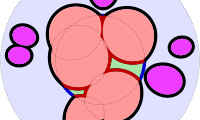 Enzymatic recycling of plastics is limited by the presence of semi-crystalline spherulites that are recalcitrant to enzymatic depolymerization. Depending on the quality of the waste stream and its treatment history, a large volume fraction of the material actually remains in form of connected clusters of such spherulites. We build on a recently published numeric method to predict the number, the connectivity, and the morphology of these clusters as an outcome of enzymatic degradation. When applied to PET waste, our method predicts that the resulting aggregates are loosely connected, “fluffy” structures with a high surface-to-volume ratio, accompanied by smaller clusters following a continuous size distribution. By providing a quantitative framework for understanding the microparticle production during the depolymerization, these findings should assist choosing a suitable downstream treatment, such as filtering or flocculation. This work could thus help to advance the enzymatic depolymerization technologies.
ACS MACROMOLECULES
By: Michael Schindler and Ludwik Leibler
Published in Issue: September 22, 2026
DOI: