 ESPCI web site



<
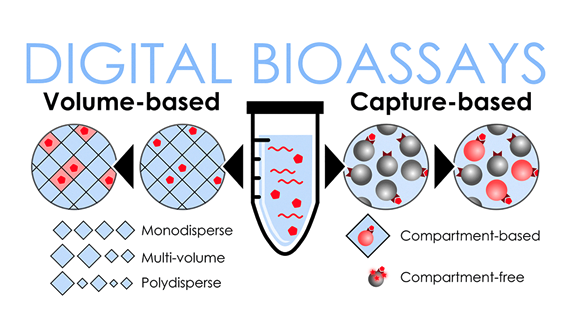 Absolute quantification of biomolecules increasingly relies on digital bioassays, which convert continuous concentration measurements into binary, countable events distributed across a large number of independent partitions. Applying Poisson statistics to the fraction of positive partitions allows target concentration to be determined without an external calibration curve, offering a level of precision and reproducibility that conventional analog methods struggle to match. In this review, we organize the diverse digital bioassay frameworks around two complementary partitioning strategies: volume-based assays, which physically divide the sample into discrete reaction vessels such as droplets or microwells, and capture-based assays, which instead capture target molecules onto individual solid supports, including microbeads and patterned microspots. Within each strategy, we highlight how design choices, partition dispersity, capture specificity, isolation format, and signal localization can be combined modularly to tune precision, dynamic range, multiplexing capacity, and operational simplicity. We further show how these two partitioning logics increasingly converge in hybrid architectures, and how compartment-free signal amplification chemistries are relaxing the historical dependence of digital detection on dedicated microfluidic hardware. By providing a unified perspective on digital quantification, this review identifies common design principles across diverse assay formats and outlines opportunities for developing simpler, more accessible, and application-specific digital bioassays.
CHEMICAL COMMUNICATIONS
By: Ulysse Le Bas and Guillaume Gines
A transparent peer review has been published:
DOI: